What Is a Sign Permit, Exactly?
A sign permit is written approval from your local government — usually the city or county planning or building department — that authorizes you to install, display, or modify a sign at a specific address. It confirms that your sign meets local zoning rules, size limits, setback requirements, illumination standards, and structural safety codes.
Permits are issued at the municipal level, not the state level. Your state may set outer limits or define what a "sign" means, but the actual permit, the application, the fee, and the inspection are all handled by your city, township, or county. This is why sign rules can vary dramatically from one zip code to the next — even within the same metro area.
When Is a Sign Permit Required?
As a general rule, a permit is required for any permanent commercial sign that is visible from a public right-of-way. This includes:
- Wall-mounted signs — fascia signs bolted to the face of your building
- Monument signs — freestanding signs on a base, close to ground level
- Pole and pylon signs — freestanding signs elevated on a pole or poles
- Projecting or blade signs — signs mounted perpendicular to a wall, extending over the sidewalk
- Awning signs — text or logos printed on or applied to awnings
- Illuminated signs of any type — including channel letters, backlit panels, and LED cabinets
- Digital and electronic message centers — LED boards that change messages
- Window signs exceeding your city's coverage threshold — typically over 25–30% of window area
- Roof signs — where allowed at all (many cities ban them outright)
What Doesn't Need a Permit?
Most sign ordinances carve out exemptions for certain sign types. Common exemptions include:
- Signs painted directly on a building (murals, hand-painted lettering) — often exempt, though not universally
- Small non-illuminated signs under a size threshold — commonly 6 square feet or less, but this varies by city from 2 sq ft to 12 sq ft
- Interior signs not visible from outside or from the public right-of-way
- Window signs under a coverage percentage — many cities allow non-illuminated window graphics covering less than 25% of the window without a permit
- Real estate "for sale/lease" signs — typically governed by a separate ordinance and allowed without a permit
- Political signs — exempt in most jurisdictions under First Amendment protections, subject to time and placement limits
- Official government signs — directional signage, traffic signs, hazard warnings
- Address numbers and building identification — required by code and exempt from permit requirements
How to Find Out Exactly What Your Location Requires
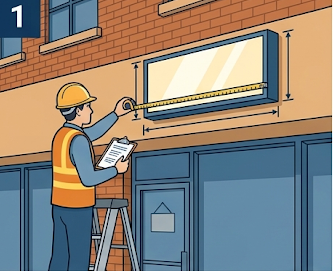
There's no shortcut here. The definitive answer for your specific sign at your specific address comes from one source: your local planning or building department.
Here's the most efficient process:
- Find your local permit authority. Search "[your city name] sign permit" or "[your city name] planning department." The issuing authority is usually the planning, zoning, or building department at city hall. In unincorporated areas, it's typically the county planning department.
- Look up your zoning district first. Most cities have an online zoning map. Enter your address to find your zone (C-1, B-2, mixed-use, etc.). Your zone determines what sign types and sizes are allowed before you even apply.
- Ask this specific question: "I want to install a [type] sign that is [dimensions] square feet on [wall/pole/window] at [address]. Is a permit required, and if so, what is the application process?" Being specific gets you a specific answer. Vague questions get vague answers.
- Request the sign ordinance. Most planning departments can email you the relevant section of the local sign code. Reading the actual ordinance is the only way to know all the rules that apply to your sign.
Permit Requirements by Sign Type — General Guide
This table reflects the most common rules across U.S. municipalities. Your city may differ — always verify locally.
| Sign Type | Permit Typically Required? | Notes |
|---|---|---|
| Wall sign (non-illuminated, any size) | Yes | Most cities require permits for all permanent wall signs |
| Wall sign (illuminated) | Yes + electrical permit | Two permits required in nearly all jurisdictions |
| Monument / ground sign | Yes | Height and setback limits apply |
| Pole / pylon sign | Yes | Often require structural engineering drawings |
| Window vinyl / lettering (non-illuminated) | Sometimes | Exempt in many cities under coverage thresholds (usually 25–30%) |
| Window neon / illuminated display | Yes | Illumination triggers permit requirement in virtually all cities |
| Digital / LED message center | Yes | Restricted or banned in many residential and historic zones |
| Temporary banner (grand opening, sale) | Usually yes (temp permit) | 30–90 day permits; limited to 2–4 per year in most cities |
| Painted sign on building | Sometimes | Many cities exempt painted signs; others treat them the same as installed signs |
| Interior sign (not visible outside) | No | Interior-only signs generally exempt everywhere |
| Sandwich board / A-frame (on sidewalk) | Often yes (sidewalk use permit) | May require a separate public way use permit |
| Vehicle graphics / wraps on business vehicles | No | Vehicle wraps are not regulated as signs |
Why Zoning Matters as Much as Sign Type
Your zoning district determines not just whether a sign needs a permit, but what signs are allowed at all. A sign that's perfectly legal on a commercial arterial road might be prohibited in a downtown historic district or a neighborhood commercial zone.
Key zoning factors that affect sign permits:
- Zone type — commercial zones generally allow larger signs than mixed-use or residential zones
- Overlay districts — historic districts, scenic corridors, and special design districts often have additional restrictions on sign types, materials, colors, and lighting
- Frontage — many sign ordinances calculate your maximum allowed sign area as a ratio of your building's linear street frontage (e.g., 1 sq ft of sign per 1 linear foot of frontage)
- Proximity to highways — signs near interstate highways may fall under additional state highway advertising regulations
What the Application Process Looks Like

While every city is different, most sign permit applications require:
- ✓ Completed application form (available from the planning or building department, often online)
- ✓ Site plan showing the property, building, and proposed sign location
- ✓ Sign drawing or rendering with exact dimensions, letter height, and materials
- ✓ Photograph of the existing building face where the sign will be installed
- ✓ Landlord/property owner authorization (if you're a tenant)
- ✓ Contractor information (if a licensed contractor is required)
- ✓ Electrical drawings (for illuminated signs)
- ✓ Permit fee (paid at submission)
After submission, a plan reviewer confirms your sign meets code. You may receive comments requesting revisions. Once approved, you're issued a permit number and typically have 180 days to install the sign and call for inspection.
How Much Does a Sign Permit Cost?
Most U.S. municipalities use one of three fee structures:
- Flat fee — a single charge regardless of sign size, common in small cities and townships. Typical range: $25–$100.
- Base fee + per square foot — a minimum charge plus an additional amount per square foot of sign area. Common in mid-size cities. Example: $75 base + $2.50/sq ft. A 20 sq ft sign = $125.
- Tiered fees — larger signs fall into higher fee tiers. Electrical permits are separate and typically add $50–$200.
Use our fee estimator to get a ballpark for your sign type and location, then confirm the exact fee with your planning department.
The Complete Guide to Zoning — Dwight H. Merriam
Written by a land use attorney, this is the clearest plain-English guide to how U.S. zoning codes work — including sign ordinances, variances, and how to navigate planning departments. Useful background for any business owner dealing with local permitting for the first time.
View on Amazon →As an Amazon Associate, SignPermitGuide earns from qualifying purchases. This does not affect our editorial coverage.
Ready to check your specific sign?
Our permit checker walks you through 5 questions about your sign type, size, placement, and illumination and gives you a clear likely-or-not answer — plus what to do next.
Use the Permit Checker →More Questions
Usually no — if the sign cabinet, structure, and dimensions aren't changing, most cities allow a "sign face change" without a new permit. However, if you're changing from a non-illuminated to an illuminated sign, or changing the size, a new permit is required. Check with your planning department to confirm what qualifies as a face change vs. a new sign installation.
Yes — property owners can apply for sign permits. In fact, many landlords include approved sign programs in their leasing packages, which simplifies the process for tenants. Some cities issue blanket sign program approvals for multi-tenant retail centers, which means individual tenants file within an already-approved framework.
Yes. Unincorporated areas fall under county jurisdiction rather than city jurisdiction, but they still have sign ordinances and permit requirements. Contact your county planning or building department. The rules may be less restrictive than in nearby cities, but permits are still required for most commercial signs.
Most multi-tenant commercial properties operate under a "sign program" — a set of approved specifications negotiated between the property owner and the city. As a tenant, your sign must comply with both the city's sign code and the property's sign program. Your landlord should provide you with the sign program specifications. Violating the sign program can result in your sign being removed even if it technically complies with the city code.
Disclaimer: The information on this page is for general informational purposes only. Sign permit requirements vary by city, county, and zoning district and are subject to change. Nothing here constitutes legal or professional permitting advice. Always verify current requirements directly with your local planning or building department before designing, ordering, or installing any sign.