Why Window Vinyl Is So Confusing
Sign vendors frequently tell customers that window lettering "doesn't need a permit." This is sometimes true — and sometimes completely wrong. The reason for the confusion is that window graphics occupy a genuine grey zone in most sign codes.
Most sign ordinances were written before applied vinyl became common. Early codes treated "window signs" as paper or paint — and often exempted them. Modern vinyl graphics, which can cover entire storefronts, blur the line between a window treatment and a wall sign. Cities have responded in three different ways:
- Coverage-percentage exemptions — the most common approach. Window signs covering less than a threshold percentage of the window area (usually 25–30%) are exempt. Over that threshold, a permit is required.
- Square footage exemptions — a fixed square footage limit (often 6–12 sq ft) applies. Under the limit: no permit. Over: permit required.
- Full exemptions — a minority of municipalities exempt all non-illuminated window signs regardless of size or coverage.
- No exemptions — some cities, particularly in dense urban areas, require permits for all window graphics applied to commercial storefronts.
Illumination Is the Bright Line
If there's one rule that applies almost everywhere, it's this: illuminated window signs require a permit.
This includes:
- Neon signs in windows
- LED light boxes or backlit panels displayed in windows
- Internally illuminated vinyl graphics
- Open/Closed LED signs
- Any sign with its own light source, even if mounted behind glass
Even cities that broadly exempt non-illuminated window graphics almost universally require permits for illuminated window displays. The electrical permit requirement adds another layer — a licensed electrician must pull an electrical permit in most states for any sign with a dedicated power connection.
How Coverage Percentage Works
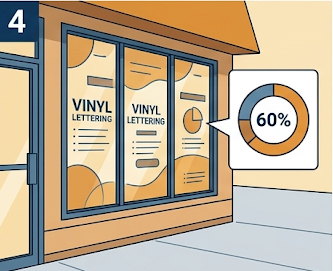
The coverage-percentage approach is the most common rule for non-illuminated window vinyl. Here's how it typically works:
Your city's sign ordinance specifies a maximum percentage of window area that can be covered by window signs without a permit. Common thresholds are 25%, 30%, or 33%.
The calculation is straightforward: divide the sign area by the total window area, then multiply by 100. A window that is 40 sq ft total, with a vinyl graphic covering 8 sq ft = 20% coverage. In a city with a 25% threshold, that's permit-free. A 12 sq ft graphic on the same window = 30% coverage, which would require a permit in most cities using a 25% threshold.
Important nuance: most ordinances measure coverage per individual window, not per storefront. A storefront with four windows can typically have each window covered up to the threshold independently — but some cities calculate the total coverage across all windows on the façade. Read your local ordinance carefully.
What Counts as a Window Sign?
Most sign ordinances define window signs broadly. In addition to vinyl lettering and graphics, the following typically count toward your window sign area:
- Applied vinyl graphics of any color or opacity
- Painted text or designs on glass
- Paper or cardboard signs taped to the inside of windows (in some cities)
- Hanging signs positioned to be seen through the window from outside
- Partially opaque or frosted vinyl panels used for decorative or privacy purposes (if they contain commercial text or logos)
Frosted or textured film used purely for privacy or UV reduction — with no text, logos, or commercial graphics — is typically exempt even in strict cities. The moment you add your business name or logo to a frosted film, it becomes a sign.
How Real Cities Handle Window Vinyl
| City / Jurisdiction | Non-Illuminated Window Rule | Illuminated Rule |
|---|---|---|
| Austin, TX | Exempt if non-illuminated and under 25% of window area | Permit required |
| Denver, CO | Exempt up to 25% window coverage per window | Permit required |
| Nashville, TN | Exempt if under 30% of window area | Permit required |
| Atlanta, GA | Exempt if non-illuminated; no size/coverage limit stated | Permit required |
| Seattle, WA | Permit required for window signs over 25% coverage or over 40 sq ft | Permit required |
| San Francisco, CA | Permit required for all window signs over 3 sq ft in most districts | Permit required |
| Chicago, IL | Exempt if non-illuminated and under 6 sq ft per window | Permit required |
| Houston, TX | Sign code applies through deed restrictions; varies by district | Varies |
| Orlando, FL | Exempt under 25% of window area if non-illuminated | Permit required |
| Phoenix, AZ | Window signs count toward total allowed sign area for the parcel | Permit required |
Source: Municipal sign ordinances, verified as of 2024–2025. Confirm current rules with each city directly.
The Exact Question to Ask Your City
When you call or visit your planning department, use this specific language:
"I want to apply a non-illuminated vinyl graphic to my storefront window. The graphic will be approximately [X] square feet on a window that is [Y] square feet total. Does this require a sign permit under your sign ordinance?"
Being specific about the dimensions and whether it's illuminated gets you a specific answer. If you just ask "do window signs need a permit?" you may get an incomplete or incorrect response from a counter clerk who defaults to the general rule.
Can I Order the Vinyl Before the Permit?
Technically yes — most cities don't require a permit before ordering materials. But you should not install the vinyl before receiving permit approval if a permit is required. Installing before approval puts you at risk of a stop-work order requiring you to remove the graphics immediately. Since vinyl installation is often destructive to remove cleanly, this can be a costly mistake.
Practical approach: apply for the permit as early as possible (you can submit the application with design drawings before the vinyl is produced), and have your installer hold off until you have the permit in hand.
Window Vinyl FAQs
Historic overlay districts almost always have additional restrictions on window signage beyond the base sign ordinance. These may include limits on vinyl graphics, requirements for specific materials (etched glass, painted lettering), color restrictions, and coverage limits far below the standard city threshold. Your permit application will also go through a historic design review, which adds time. Contact your city's historic preservation office first before planning any window signage in a historic district.
Landlord opinions on sign permits are frequently wrong. Landlords may be telling you what their previous tenants did (which may not have been compliant), or may be applying a rule that was accurate when they last checked but has since changed. Responsibility for a sign permit violation falls on the business owner and/or the property owner depending on your jurisdiction. Get confirmation from the planning department directly — not from your landlord, your sign company, or anyone else with an interest in the outcome.
Yes, perforated vinyl (sometimes called one-way vision film) that covers a significant portion of a window and contains commercial graphics is treated as a window sign in most jurisdictions. It's counted toward your window coverage percentage. The fact that it's see-through from inside doesn't change its status as a sign visible from outside. Some cities have specific provisions for vehicle-mounted window graphics; storefront applications are generally regulated the same as other window signs.
This is where it gets genuinely nuanced. Most sign codes distinguish between "informational" and "advertising" content. Hours of operation, emergency contact numbers, and address information are commonly excluded from sign calculations or explicitly exempted. However, the moment you add your business name, logo, or a tagline, the entire graphic typically becomes a sign. Many cities exempt "business identification information" in small text near the door, but this exemption is narrowly written. When in doubt, ask your planning department specifically about hours/contact information on door glass.
Temporary window signs — paper posters, fabric banners hung in windows, and short-term promotional displays — are usually regulated separately from permanent signage. Many cities allow temporary window signs for up to 14–30 consecutive days without a permit, with limits on how many times per year you can use that exemption. Temporary vinyl applied and then removed within the temporary sign period may qualify for this exemption. Confirm with your city's definition of "temporary" before assuming this applies to your situation.
Not sure about your specific sign?
Use our permit checker to answer five quick questions and get a clear indication of whether your window sign is likely to need a permit.
Use the Permit Checker → Full permit guide →Disclaimer: Information on this page is for general informational purposes only. Sign regulations vary by city, county, and zoning district and change frequently. Always confirm current requirements directly with your local planning or building department before designing, ordering, or installing any signage.