Common Exemptions in Most U.S. Sign Codes
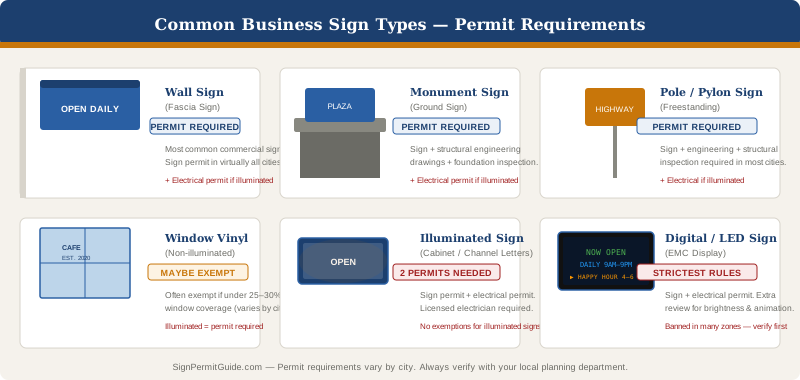
While sign ordinances vary widely, the following exemptions appear in most U.S. municipal sign codes. These are the sign types that most often do not require a permit — but always confirm locally.
Interior Signs
Signs located entirely inside a building and not visible from outside or from a public right-of-way are universally exempt from sign permit requirements. This is the clearest and broadest exemption in American sign law. Signs on interior walls, hanging from ceilings inside, and mounted behind reception desks all qualify.
The edge case: A sign mounted inside but visible through a large window from the street is treated as a window sign by most ordinances, not an interior sign. Placement matters more than whether the sign is technically inside the building.
Small Non-Illuminated Signs
Most sign codes establish a minimum size threshold below which a permit is not required for non-illuminated permanent signs. Common thresholds:
- Under 2 square feet — the strictest threshold, found in some urban and historic areas
- Under 6 square feet — the most common exemption threshold in mid-size cities
- Under 12 square feet — found in some smaller cities and rural townships
- Under 32 square feet — rare, usually in very rural or unincorporated jurisdictions
The threshold almost always requires the sign to be non-illuminated. Any light source — even an externally mounted spotlight aimed at the sign — typically voids the size-based exemption.
Painted Signs Directly on Buildings
Signs painted directly onto a building's wall surface (not applied vinyl, not an attached panel — actually painted) are exempt in many municipalities. The rationale is that painted signs are structural modifications to the building itself rather than separate sign installations.
This exemption is narrower than it sounds. Applied vinyl graphics (even hand-lettered-looking vinyl) are not painted signs. A sign panel painted in a shop and then bolted to the building is not a painted sign. Only direct application of paint to the existing wall surface qualifies in most cities.
Even where painted signs are exempt from sign permits, they are still subject to the underlying zoning rules about content and placement, and some cities have eliminated this exemption entirely.
Window Graphics Under Coverage Threshold (Non-Illuminated)
As covered in our window vinyl guide, most cities exempt non-illuminated window graphics covering less than 25–30% of the window area. This is the most commonly used exemption for small businesses.
Address Numbers and Building Identification
Street address numbers, suite numbers, and basic building identification are required by code (fire safety, mail delivery) and are universally exempt from sign permit requirements. The exemption covers numbers displayed on or near the main entrance, on mailboxes, and at driveways or access points.
Real Estate Signs
Temporary "for sale," "for lease," and "for rent" signs are regulated separately from commercial signage in most jurisdictions. They're typically allowed without a sign permit, subject to size limits (usually 4–16 sq ft for residential, larger for commercial) and time limits (must be removed within a specified period after sale/lease). These signs must be on the property being sold or leased.
Political and Non-Commercial Signs
Political signs (election campaign signs, advocacy signs) receive special treatment under First Amendment protections in most jurisdictions. They're generally exempt from sign permits and allowed in most zones, though municipalities can regulate their placement, size, and time period (typically removal within 10–30 days after the election). Non-commercial message signs (community notices, religious messages) often receive similar treatment.
Construction and Development Signs
Signs posted on active construction sites describing the project, contractor, and architect are typically exempt from standard sign permits or subject to a simplified permit process. Size limits apply (commonly 32 sq ft for residential, 64 sq ft for commercial projects).
What Is NOT Typically Exempt
Despite common assumptions, the following sign types are generally not exempt:
- Any illuminated sign, regardless of size
- Permanent wall signs over the size threshold
- Monument, pole, or pylon signs of any size
- Awning signs and projecting signs
- Temporary banners left up longer than the city's temporary sign period (usually 14–30 days)
- Digital or electronic displays of any kind
- Vehicle wraps on stationary vehicles used primarily as signs (a van parked permanently in front of your business to serve as a sign is regulated as a sign in many cities)
How to Verify an Exemption
If you believe your sign qualifies for an exemption, don't just assume — verify. The two-step process:
- Find your city's sign ordinance online. Search "[city name] municipal code signs" or "[city name] sign ordinance." Look for the exemptions section (often titled "Signs Exempt from Permit Requirements" or "Permits Not Required").
- If the ordinance text is ambiguous, call your planning department. Ask: "Is a [describe sign exactly] exempt from sign permit requirements under your sign ordinance?" Get the answer confirmed by email if the stakes are high.
Keep any written confirmation. If you're ever cited, documentation that you verified the exemption is your strongest defense.
Exemption FAQs
No formal action is required for truly exempt signs. You don't file an exemption claim or register the sign. Simply confirm the sign meets the exemption criteria and keep documentation of that confirmation. If you're ever questioned by code enforcement, your ability to point to the specific ordinance language and your confirmation from the planning department is sufficient.
No. Permit exemptions only mean you don't need to file a permit application — they don't exempt the sign from the zoning rules about content, placement, and size. An exempt-sized sign still cannot violate your zone's placement rules (setbacks, placement on adjacent property, blocking traffic sight lines). The sign must still meet all applicable regulations; it just doesn't require a permit to prove compliance in advance.
Most sign codes count all signs toward your total allowed sign area, including exempt signs. So while a single 5 sq ft sign may be exempt from permit requirements, two 5 sq ft signs might push you over your zone's total allowed sign area — even if each one individually would be exempt. The exemption threshold and the maximum allowed sign area are separate calculations. If you're planning multiple signs, calculate your total and compare it to your zone's maximum.
Not sure if your sign qualifies?
Our permit checker walks through your sign type, size, illumination, and location to give you a likely answer in under 2 minutes.
Use the Permit Checker →Disclaimer: Sign permit exemptions vary by city, county, and zoning district. This page reflects common patterns in U.S. sign ordinances and is not a substitute for verification with your local planning department. Always confirm exemption status before installing any sign.